Adopt
Learn More About Our Adoption Process
If you're interested in adopting a cat or kitten from The Silent Prayer Rescue, please keep the below information in mind. The Silent Prayer Rescue is a foster-based rescue located on Long Island, meaning we schedule meet and greets with our furry friends by appointment only. Due to pets being in private residencies, all adopters must submit an application and be approved prior to any meet and greet. Meet and greets are typically scheduled between 11am and 5pm.
Ensuring Loving Homes
To ensure loving homes for all cats and kittens in our care, we require you to submit the following information in your application:
• Leasing information if a renter
• Landlord's name and number for verification if needed
• Veterinary information
• 3 personal, non-family-member references
• Virtual home visit completed before the application is finalized and approved
Why Kittens Should Be Adopted in Pairs
Two Kittens, One Healthier Start
Kittens are social, curious, energetic little animals who learn about the world through play, exploration, and interaction. During their early months, they develop social skills, boundaries, and behaviors that shape them into adult cats. A feline companion can make a meaningful difference in their development, confidence, and well-being.
At The Silent Prayer, we strongly encourage kittens under 14 weeks of age to be adopted in pairs, ideally with a sibling or familiar kitten. We understand two kittens may not suit every household, so we want adopters to understand why companionship matters during kittenhood.
What Is Single Kitten Syndrome?
“Single Kitten Syndrome” is an informal term used by some rescues and feline behavior professionals to describe challenges that may arise when a young kitten grows up without adequate feline companionship. It is not a formal veterinary diagnosis, and not every kitten raised alone will develop difficulties. However, a suitable feline playmate gives kittens valuable opportunities to learn appropriate social behavior.
Through wrestling, chasing, gentle biting, and other play, kittens learn to moderate their behavior. If play becomes too rough, a playmate may squeal, disengage, or respond in a way that teaches the kitten to adjust. These interactions help kittens learn bite inhibition, respect boundaries, recognize social cues, and regulate excitement. Human caregivers are essential, but we cannot perfectly replicate cat-to-cat communication.
What Behavioral Challenges Can Develop?
Every kitten is an individual, and raising one alone does not guarantee behavioral problems. Limited feline socialization and play can contribute to challenges such as:
- Play aggression and hard biting. Without feedback from a playmate, some kittens may have more difficulty learning when play is too rough, and may bite hands or feet or ambush their people.
- Excessive energy and destructive behavior. Young kittens need frequent play. Without companionship and enrichment, they may direct their energy toward furniture, household objects, or people.
- Attention-seeking or difficulty being alone. Some kittens may struggle to settle independently or vocalize persistently. These behaviors have many possible causes; a second kitten is not a guaranteed solution.
- Difficulty reading feline social cues. Limited interaction may make it harder for some cats to interpret other cats’ body language or navigate future introductions.
- Boredom and frustration. When people are unavailable, a kitten without an appropriate playmate may have fewer outlets for natural play and exploration.
These challenges are not inevitable. Socialization, enrichment, interactive play, and individual attention all matter. Two compatible kittens simply have an additional source of companionship and a chance to learn from each other.
Why Two Kittens Are Often Better Than One
- Learn boundaries: practice moderating bites and respecting social signals.
- Burn energy together: chase, wrestle, and play in ways that meet natural instincts.
- Provide companionship: play, rest, groom, and explore together when their family is busy.
- Build confidence: a familiar companion may help a kitten feel secure in a new environment.
- Reduce boredom: shared play adds enrichment alongside toys and human attention.
- Develop social skills: regular interaction provides opportunities to practice communication and healthy play.
Two kittens still need individual attention, proper introductions to other pets, veterinary care, and an enriched environment. A companion is not a substitute for responsible care, but can be a wonderful addition to a kitten’s life.
Our Adoption Policy: When Can Kittens Be Adopted Alone?
Our goal is to place every kitten in a home where they can thrive for a lifetime. Kittens younger than 14 weeks are adopted in pairs, preferably with a sibling or familiar kitten companion. Single-kitten adoptions may be considered between 14 and 16 weeks based on the individual kitten’s personality, social development, and circumstances. Kittens under 16 weeks generally need a feline companion; a young, playful, well-socialized resident cat may be suitable in some homes. We assess each situation individually.
Our policy is not intended to discourage adoption. It is intended to help set each kitten up for a successful transition and reduce the risk of preventable social or behavioral difficulties.
Two Tiny Lives, One Wonderful Beginning
We know adopting two kittens is a commitment, and every household has different circumstances. Our responsibility extends beyond finding kittens homes: we want them to become confident, happy, well-adjusted cats. When you adopt a pair, you give two young animals a built-in companion and an opportunity to grow together. At The Silent Prayer, we believe the best adoptions put lifelong well-being first. Sometimes, the best beginning is two.
For more information about feline social behavior, please read the Merck Veterinary Manual: Social Behavior of Cats.
Adoption Fees and What They Cover
- Cats and kittens under 7 years old: $250
- Cats over 7 years old: $200
- Pair adoption (2 cats): $475
- Triple adoption (3 cats): $675
Every adoption helps us continue our mission of rescuing, rehabilitating, and finding loving homes for cats in need. Thank you for supporting our rescue!
Included Medical Care
Adoption fees include spay/neuter, SNAP test for FIV/FeLV, age-appropriate vaccines up to date at the time of adoption, deworming, flea treatment, and microchipping. The specific care completed for each cat depends on age, medical history, and veterinary guidance; we will explain the individual cat’s records during the adoption process.
What You Need to Know Before Applying
Please review these requirements carefully before submitting an application. They help us assess whether each placement will be safe and successful for both the cat and the adopter.
- Age: Applicants must be at least 21 years old.
- Applications are not first-come, first-served: Submitting an application does not guarantee adoption of a particular cat or kitten. If your preferred kitten is adopted, we will do our best to help identify another good match.
- Successor caregiver for adopters 65 and older: A designated successor caregiver must be listed on the adoption agreement and agree to assume responsibility for the animal if the adopter becomes unable to care for them or passes away. This helps ensure the pet has a safe, planned landing place.
- Primary caregiver: The applicant must be the primary caretaker and owner.
- Renters: Provide a current lease or rental document confirming pets are permitted. Your legal name and residential address must be visible.
- Landlord consent: Applicants must have their landlord’s knowledge and approval when applicable.
- Long-term care: Applicants must be able and willing to provide appropriate time, attention, and necessary veterinary care.
- Application outcome: Completing the form does not guarantee approval or adoption.
- Application exclusivity: Please do not apply with another rescue or shelter for at least 72 hours after applying to The Silent Prayer, so we have a reasonable opportunity to review your application.
- Adoption contract: An adoption contract must be signed at adoption. You may request to review it after approval; otherwise, it will be provided at least 24 hours before the adoption for your review.
Meet and Greets
Personal pets may not accompany adopters to meet-and-greets. Our cats live in foster caregivers’ private homes, where the caregivers may have pets of their own. This policy helps protect the comfort, safety, and health of all animals involved.
Important to Know
If circumstances ever change and you can no longer keep a cat adopted from us, please contact The Silent Prayer. We will always take our cats back. Once a TSP cat, always a TSP cat—whether it is five, ten, or fifteen years later. Their safety and well-being remain important to us throughout their lives.
View Our Adoptables
To find out more information on our adoptable cats and kittens, please view below.
Adoption Application
Ready to apply? Please complete our adoption application below.
Open Adoption ApplicationWhat Does a “Free” Kitten Really Cost?
A kitten offered at no initial cost may still need important veterinary services. The chart below compares estimated out-of-pocket costs for a kitten obtained for free with the listed adoption-fee range for a rescue or shelter cat.
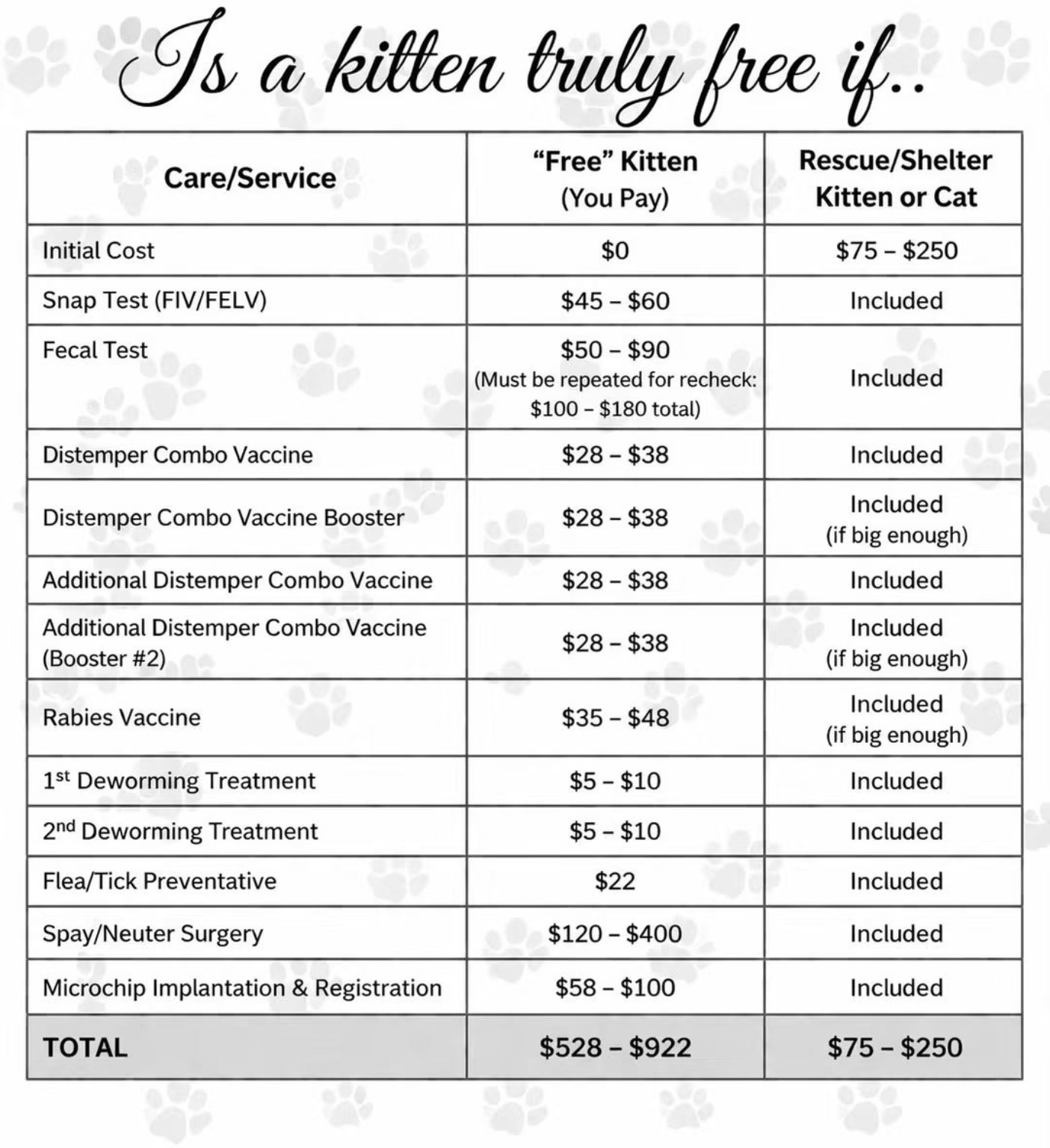
Cost estimates are illustrative and can vary by clinic, location, age, health, and services already completed. The chart reflects the figures shown in the supplied reference; it is not a guarantee that every rescue cat receives every listed service or that every free kitten will need every item. Ask for the individual animal’s medical records and confirm local veterinary pricing.